Ten Key Features of Certified ISO Cleanrooms
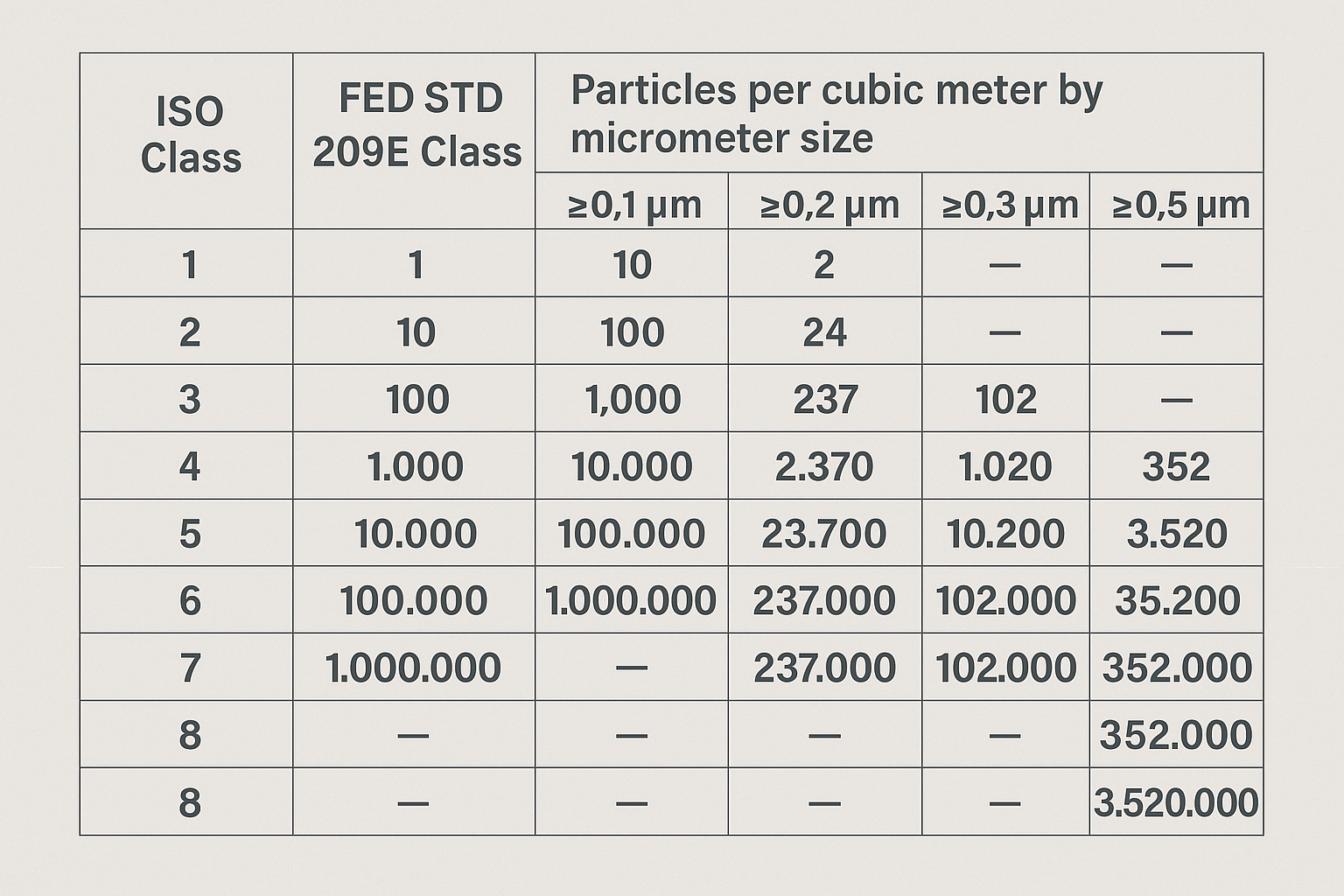
Cleanrooms are classified under ISO 14644, which defines air cleanliness by particle concentration on a scale from ISO 1, the cleanest, to ISO 9. Rooms are certified to a specific class through particle count testing. These environments underpin work in pharmaceuticals, semiconductor manufacturing, battery production, and aerospace, where contamination that would go unnoticed elsewhere can ruin a production run.
1. Documentation and Compliance
Standard operating procedures, audit records, and maintenance logs provide the traceability that lets a facility demonstrate its cleanroom performed within specification on any given date. Certification is not permanent either. The standard requires periodic retesting, more frequently for stricter classes, and a room is only certified as long as that testing continues.
2. Environmental Monitoring Systems
Real-time systems track particle counts, temperature, humidity, and differential pressure. Cleanrooms are held at positive pressure relative to adjoining areas, so air flows outward through door seams rather than inward. That pressure cascade is what keeps contamination out when a door opens. Alarms flag drifting readings so operators can respond before product is affected.
3. Personnel Protocols and Hygiene
People are the largest single source of contamination, shedding skin cells, hair, and fibers continuously. Gowning contains that. Required garments vary by classification but generally include a coverall or smock, gloves, shoe covers, a hair cover, and a face mask, put on in a specified order inside a dedicated gowning room.
4. Air Filtration and Air Change Rates
HEPA and ULPA filters are the two grades used in cleanrooms, with ULPA rated higher and generally required for stricter classes. Filtration alone does not maintain a class. Air change rate, the number of times per hour the room's air volume is replaced, flushes particles out rather than letting them settle. Filters are tested and replaced on schedule, since a loaded filter changes the airflow pattern.
5. Design and Construction
Cleanroom architecture eliminates the places where particles generate or collect. Surfaces are smooth and non-shedding, corners are coved rather than square so no seam traps particles, and fixtures are flush-mounted rather than protruding. Every penetration for piping or ductwork is a path for unfiltered air, so seal integrity is tested at certification.
6. Controlled Access and Entry Protocols
Entry runs through an airlock, a buffer space between the cleanroom and the area outside it. Interlocked doors prevent both sides from opening at once, preserving the pressure differential. Access is restricted to authorized personnel, and traffic is held to what the work requires.
7. Cleaning and Maintenance Practices
Cleaning follows defined schedules using materials rated for the environment: non-shedding wipes, cleanroom-compatible mops, and approved agents. Ordinary janitorial supplies introduce more contamination than they remove. Surfaces are cleaned in overlapping unidirectional passes rather than circular motions, working from cleanest to least clean so contamination leaves the space rather than moving around within it.
8. Contamination-Resistant Equipment and Furniture
Furniture and fixtures are chosen for materials that do not shed and can survive repeated chemical cleaning. Stainless steel is the common choice because it is non-porous, does not outgas, and tolerates aggressive cleaning agents, and electropolished finishes reduce the surface roughness where particles adhere. Wood, particleboard, and painted surfaces are avoided for the opposite reasons.
9. Training and Certification Programs
Personnel training covers gowning, hygiene, movement discipline, and contamination prevention, and it repeats on a schedule rather than happening once at onboarding. This is separate from the room's certification: a facility can hold a valid classification and still fail in practice if the people inside it are not trained to maintain it.
10. Emergency Response and Contingency Planning
Response plans cover the failures that would compromise the environment: power loss, air handler or filter failure, pressure excursions, and chemical spills. Loss of pressurization or airflow means the room is no longer performing to its class regardless of the last certification, so plans specify recovery steps and, depending on severity, retesting before the space returns to service.
Certification is a measurement taken at one point in time. What holds it between measurements is the design, the monitoring, and the people trained not to undermine either.